
How to Choose the Perfect Wedding Venue in Malta
By secteam
Most couples start their search by asking which venue in Malta is the best. It is the wrong question, and it is the reason so many searches stall after a few weeks of scrolling.
There is no single best wedding venue in Malta. There is a venue that fits your guest count, your season, your budget and the kind of day you actually want, and there are dozens that don’t. Once you know which category you belong in, the shortlist shrinks from a hundred options to five, and the decision becomes straightforward.
This guide walks through the main types of wedding venue in Malta, what each one genuinely suits, and the questions worth asking before you commit to anything.
First, a word about Malta as a wedding destination
Malta is a small archipelago in the middle of the Mediterranean, three hours from Paris and roughly the same from London. Three things make it unusually practical for a wedding abroad.
English is an official language. Every contract, every supplier conversation and every legal form will be in a language you can read, which is not the case in most Mediterranean destinations.
It is in the EU and the eurozone. No currency conversion, no customs paperwork for your dress or your stationery, and, importantly for the legal side, no apostille required on public documents issued in another EU country.
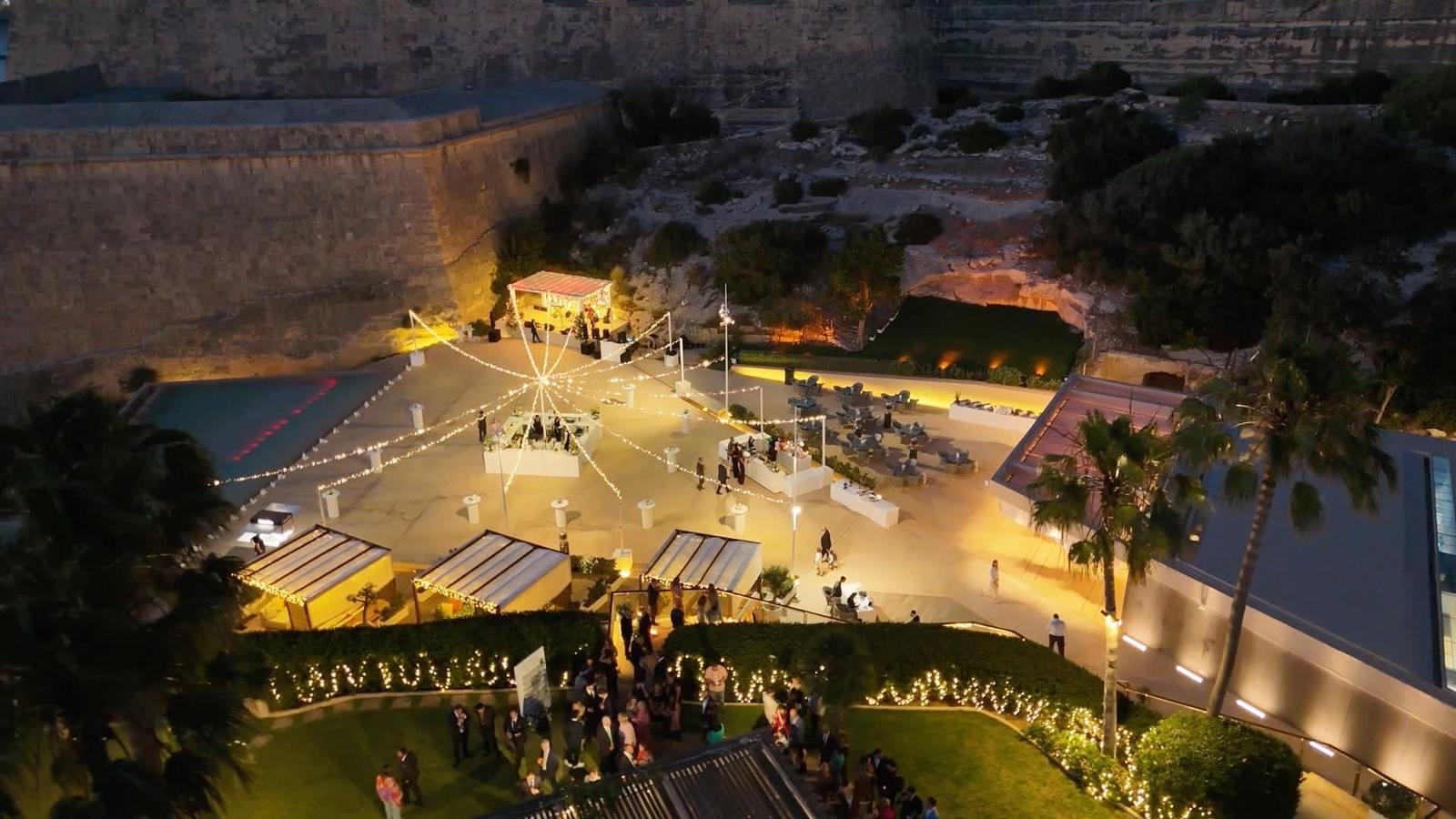
And it is genuinely compact. You can hold your ceremony in a walled medieval city and your dinner by the sea forty minutes later. Guest transfers that would be a logistical problem elsewhere are a short coach ride here.
The seven types of wedding venue in Malta
Almost every wedding location in Malta falls into one of these categories. Read them as a filter, not a wish list.
Historic palazzos
Malta’s baroque palazzos are the reason many couples look at the island in the first place: painted ceilings, formal gardens, limestone courtyards, centuries of history. They photograph exceptionally well and they impress guests from the moment they walk in.
Suits: 60 to 150 guests, formal dinners, couples who want a sense of occasion. Consider: these are the most sought-after venues on the island and they book early, often 12 to 18 months ahead for a Saturday in peak season. Many are heritage-listed, which can restrict what you may attach to walls, where open flames are allowed, and how late music can run. None of this is a problem, but it must be established before you sign, not after.
Private villas and their gardens
A step less formal than a palazzo, and often more flexible. Private villas typically come with mature gardens, a pool, and the option of exclusive use of the whole property.
Suits: 40 to 120 guests, multi-day celebrations, couples who want the venue to themselves. Consider: exclusivity is the real value here, and it is worth paying for if a private day matters to you. Check whether the rental includes overnight accommodation for the couple and close family, it often does, and it changes the value calculation considerably.
Farmhouses
The traditional Maltese razzett, thick limestone walls, a central courtyard, usually a pool. Rustic in the best sense, and very well suited to relaxed, warm celebrations rather than formal ones.
Suits: 30 to 80 guests, long-table dinners, couples who want an unfussy day. Consider: most farmhouses are in the countryside or on Gozo, so factor in guest transport and, if the party runs late, where everyone sleeps. For fewer than 40 guests, see also our guide to small and intimate weddings in Malta, the choice of venue changes considerably at that scale.
Seafront and coastal venues
Terraces above the water, harbour views, sunset behind the ceremony. Malta’s coastline is its strongest visual asset and a seafront venue makes full use of it.
Suits: almost any guest count, ceremony-at-golden-hour timings. Consider: wind. Malta is a windy island, and exposed coastal terraces are the first places to feel it. If the sea is central to what you want, our guide to beach and seafront weddings in Malta covers the coastal options in detail, including what is realistic and what isn’t. A veil, a lightweight tablescape and a two-tier cake all behave differently in a fifteen-knot breeze. Ask any coastal venue directly which wind direction affects them and what their contingency is, a good venue will answer immediately, because they are asked this every week.
Hotels and resorts
The practical option, and an underrated one. Ceremony space, reception, catering and guest accommodation in a single location, with an events team that runs weddings continuously.
Suits: larger guest counts, international guest lists, couples who want logistics simplified. Consider: you are unlikely to have the property to yourself. If the idea of other guests in the lobby in swimwear bothers you, look elsewhere. If it doesn’t, the convenience is real, particularly for elderly guests or families with small children who can go up to their room at nine o’clock.
Historic gardens and heritage sites
Formal gardens, restored estates, and cultural sites that open for private events. Often the most distinctive settings on the island.
Suits: 50 to 120 guests, daytime and early evening celebrations. Consider: these sites usually operate under conditions set by a heritage authority. Access times, music levels and end times tend to be firmer than at a commercial venue, and they are rarely negotiable. Establish them early.
Gozo
Malta’s sister island deserves its own category. Slower, greener, more rural, and noticeably quieter, a genuinely different atmosphere from the main island.
Suits: couples who want intimacy and landscape over grandeur. Consider: everything has to cross on the ferry, including your suppliers. That is entirely manageable and Gozitan weddings happen constantly, but it needs building into the schedule rather than discovering on the day. Note also that couples marrying on Gozo apply for their marriage banns at the Marriage Registry in Victoria rather than in Malta.
Where in Malta? A short geography
Couples often search by area before they search by venue type. Broadly:
Valletta – the capital and a UNESCO World Heritage site. Baroque architecture, harbour views, exceptional photographs. Limited large-capacity venues, and access and parking need planning.
Mdina and Rabat – the old walled capital, known as the Silent City. Medieval streets, dramatic light in the late afternoon, an unmistakable sense of place. Vehicle access inside the walls is restricted.
Naxxar, Attard and the central villages – where a high concentration of palazzos and villa venues sits. Central, well connected, easy for guest transfers.
Wardija and the northwest – countryside and open views, popular for farmhouse and villa weddings.
Sliema and St Julian’s – the modern seafront strip. Hotels, restaurants and nightlife, convenient for guests who want things to do either side of the wedding.
The north and the bays – closest to Malta’s sandy beaches and to the Gozo ferry.
The questions that actually narrow the shortlist
Venue websites tend to answer the wrong questions beautifully. These are the ones that decide whether a venue works for you.
What is the wet-weather plan, and can I see it? Malta’s summers are reliably dry, but shoulder-season weddings need a genuine indoor alternative, not a marquee that has to be booked separately at the last minute. Ask to see the actual space.
What time must music stop? This varies by venue and by location, and it shapes your entire evening. Get it in writing.
Is catering in-house or do I bring my own? In-house catering is simpler, but it means your menu and your budget are set by the venue. External catering gives you freedom and adds coordination. Neither is wrong; you need to know which you’re buying.
How many weddings do you host per day? A venue running two weddings on a Saturday is a different experience from one running yours alone.
What is the real capacity, seated, with a dance floor? Standing capacity and seated-with-dancing capacity can differ by a third. Ask for the second number.
Which direction does the wind come from, and what happens then? Covered in the seafront section above, and worth asking anywhere with an outdoor element.
What is included, and what is quoted separately? Chairs, linen, lighting, sound, staffing, corkage, cleaning. The gap between a headline venue fee and a final invoice is almost always made up of these.
Timing your search
Popular venues in peak season, May to October, Saturdays especially, book 12 to 18 months ahead. Outside that window there is considerably more availability.
It is worth considering the shoulder months seriously. April, May, late September and October offer comfortable temperatures, better light for photographs, and noticeably better availability than July and August, when Malta is at its hottest and busiest. A midweek date in May will open doors that a Saturday in August will not.
A note on choosing without seeing
Most couples planning a wedding in Malta from abroad will book their venue having visited once, or not at all. That is normal and it works, provided someone has stood in the space, checked the sightlines, seen where the sun sets in your month and read the contract properly.
If you are planning remotely, either budget for a dedicated scouting trip or work with someone on the island who can do that on your behalf. Photographs on a venue’s website are taken by professionals in perfect conditions, and they are not a substitute for either. Our article on whether you need a wedding planner in Malta sets out where that help is worth paying for and where it isn’t.
Frequently asked questions
How much do wedding venues in Malta cost?
It varies widely by venue type, season, day of the week and what is included in the hire fee. Exclusive-use private properties in peak season sit at the top of the range; hotel packages and midweek dates in the shoulder season at the more accessible end. Because so much depends on inclusions, a headline figure is misleading, a detailed quotation based on your guest count and date is the only reliable number. Our article on what a wedding in Malta costs sets out each variable in turn.
When should I book my venue?
For a Saturday between May and October, 12 to 18 months ahead. For midweek or shoulder-season dates, 8 to 12 months is usually comfortable.
Can we get legally married at any venue in Malta?
Civil ceremonies may be held at the Marriage Registry or at another location, with a different official fee applying to each. The venue and the date must be notified to the Marriage Registrar as part of the banns application. The full requirements are set out in our guide to civil weddings in Malta.
What is the best month for a wedding in Malta?
May, June, late September and October offer the best balance of weather, light and availability. July and August are hot, regularly above 30°C , which affects outdoor daytime ceremonies and guest comfort more than couples expect.
Do we need to visit Malta before booking?
It helps, but it is not essential, provided someone reliable has seen the venue in person and reviewed the contract on your behalf.
Are there wedding venues on Gozo?
Yes, and it is a genuinely different atmosphere, quieter and more rural. Plan for the ferry crossing in your supplier and guest logistics, and note that banns for a Gozo wedding are filed in Victoria.
Choosing well, rather than choosing quickly
The couples who are happiest with their venue are rarely the ones who found the most beautiful property. They are the ones who worked out what kind of day they wanted first, and then chose the venue that made that day easy.
If you are at the very beginning, our complete guide to getting married in Malta covers the whole journey, legal steps, timings, budget and season, and is the better place to start.
Signature Events plans bespoke destination weddings in Malta on an à-la-carte basis rather than through fixed packages. If you would like a shortlist built around your guest count, your season and your budget, with the contract questions above already asked, we would be glad to help.